
The short answer
Every agency can show you polished work. Every proposal can sound sensible. And two quotes that look similar on the surface can include completely different levels of strategy, design, development and support.
The right agency is not automatically the biggest, cheapest or the one with the nicest portfolio.
It is the team whose process, people and technical capability fit the problem your website actually needs to solve.
Here are the questions worth asking before you hire anyone.
Start with what the website actually needs to change
Before you compare agencies, get clear on the problem.
Not the number of pages.
Not the colour palette.
The problem.
Maybe the current site does not explain the business properly.
Maybe it looks dated and undermines trust.
Maybe people visit but do not enquire.
Maybe the website cannot handle ecommerce, integrations or internal workflows the business now needs.
Or maybe the current website is actually fine and the problem is somewhere else entirely.
A decent agency should be interested in that before recommending a solution.
At minimum, try to define:
- what you want the website to achieve
- who needs to use it
- what is not working now
- any functionality or integrations you know you need
- what success would look like afterwards
That gives you something meaningful to compare agencies against.
12 questions to ask a web design agency before you hire them
1. Who is actually going to work on the project?
Ask who will be involved after the sales call.
Who leads strategy?
Who designs it?
Who develops it?
Who is your day-to-day contact?
Will any of the work be subcontracted?
There is nothing automatically wrong with subcontractors, freelancers or specialist partners.
The issue is not knowing who you are actually buying.
The team presented during the pitch should not disappear the second the deposit is paid.
2. How will you understand our business before you start designing?
A website should not begin with:
“What colours do you like?”
The agency should want to understand the business, customer, offer, competitors, commercial priorities and existing friction.
Ask what their discovery process actually involves.
If the entire strategic phase is a short questionnaire followed immediately by design concepts, it is worth understanding what decisions are being made and on what evidence.
3. Can you show us relevant live work?
A portfolio is useful.
But screenshots only tell you what something looked like when it was photographed.
Ask to see live websites.
Use them on your phone.
Try the forms.
Look at how quickly they load.
See whether the journey makes sense.
And ask the agency what problem each project was trying to solve.
Relevant work does not necessarily mean they need to have built a website for an identical company.
You are looking for evidence that they can solve a similar level of problem.
4. What exactly is included in the quote?
This is one of the biggest reasons website quotes can look wildly different.
One proposal might include:
- discovery and strategy
- UX
- bespoke design
- copy support
- development
- integrations
- analytics
- redirects
- testing
- launch support
Another might be pricing design and development only.
Neither is automatically wrong.
But they are not the same product.
Ask what is included, what is excluded and what would trigger additional costs.
If you are still working out what a website should realistically cost, our guide on how much a website costs in the UK breaks the main options down.
5. Is the site bespoke or built from a template?
Again, neither answer is automatically bad.
Templates can be completely sensible for straightforward requirements and smaller budgets.
Bespoke design makes more sense when the website needs to reflect a distinctive brand, solve more complicated user journeys or handle functionality that does not fit neatly into an off-the-shelf structure.
The useful question is:
Why has the agency chosen that approach for your project?
They should be able to explain it without making one option sound universally superior.
6. Who is responsible for the content?
A beautifully designed website with weak copy is still a weak website.
Ask who is responsible for:
- page structure
- messaging
- written copy
- imagery
- photography
- video
- migration of existing content
Some agencies include this.
Some provide guidance but expect the client to write everything.
Some work with specialist copywriters and content teams.
The important thing is to know before the project starts.
7. Can you handle the development and integrations we need?
If the website is more than a brochure, ask about the technical side early.
That could include:
- ecommerce
- payment systems
- APIs
- booking systems
- dashboards
- forms
- CRM or system integrations
- customer areas
- custom functionality
Ask for examples of similar technical work where possible.
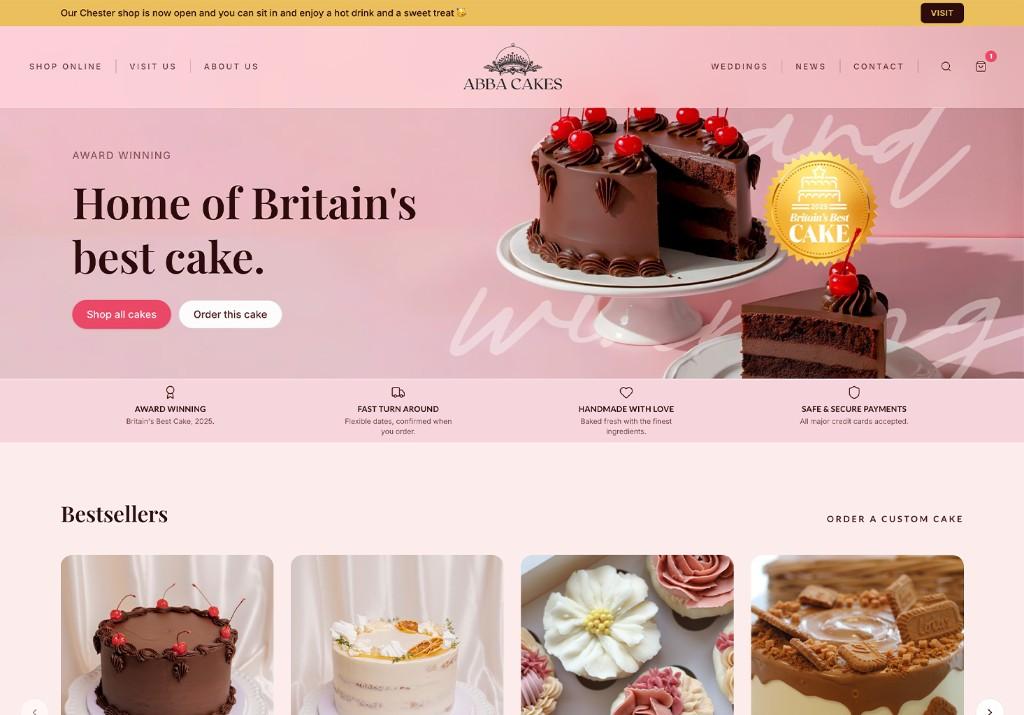
For example, our work with Abba Cakes involves a headless ecommerce storefront, WooCommerce, Square-powered checkout and bespoke order-management workflows.
The point is not that every website needs that level of complexity.
Most do not.
The point is that the agency should be capable of explaining what your business actually requires.
8. What happens to our existing search visibility?
This matters particularly if you are redesigning an existing website.
Changing URLs, removing pages or restructuring a site can affect existing organic visibility.
Ask what happens to:
- current URLs
- redirects
- page metadata
- internal links
- existing high-performing content
- Search Console and analytics
You do not need the agency to promise rankings.
In fact, anyone promising a guaranteed Google position deserves more scrutiny.
But they should understand how to avoid throwing away value that already exists.
9. Who owns the website, domain and accounts?
Get this clear before signing anything.
Who owns:
- the domain
- the website
- the code
- design files
- hosting account
- analytics
- Search Console
- third-party accounts
You should understand exactly what happens if you decide to work with someone else later.
A website should not become impossible to move because the agency relationship ends.
10. How do you test the site before it launches?
Ask what QA actually means.
Good testing might include:
- mobile and desktop layouts
- browsers
- forms
- links
- ecommerce journeys
- accessibility basics
- performance
- analytics
- metadata
- redirects
- structured data where relevant
“We check it before launch” is not much of an answer.
They should have a repeatable process.
11. How do feedback and revisions work?
Find out:
- when you will see work
- how feedback is gathered
- how many revision rounds are included
- who signs things off
- what happens if the project scope changes
“Unlimited revisions” sounds attractive but can hide a lack of structure.
A defined process usually creates a better project because everyone knows when decisions need to be made.
12. What happens after launch?
A launch date should not be the first time anyone discusses this.
Ask:
- is any post-launch support included?
- how are bugs handled?
- who manages updates?
- what ongoing costs exist?
- can your team edit content?
- what happens if you need new functionality later?
- are you tied into any minimum-term contract?
You do not necessarily need a long-term support agreement.
You just need to know what the arrangement is.
How to compare web design proposals properly
Do not compare the totals first. Compare the scope.
Put the proposals next to each other and look at:
| Area | Agency A | Agency B | Agency C |
|---|---|---|---|
| Discovery / strategy | |||
| UX / structure | |||
| Bespoke design | |||
| Copy/content support | |||
| Development | |||
| Integrations | |||
| SEO migration | |||
| Testing | |||
| Analytics | |||
| Launch support | |||
| Ongoing costs |
You may discover the cheapest quote is genuinely better value.
You may also discover it is cheaper because several pieces of work are simply missing.
That is what you need to know.
Red flags worth taking seriously
A few things should prompt more questions.
- They cannot clearly explain who does the work.
- They do not ask much about the business before proposing a solution.
- Everything is sold through portfolio screenshots with little explanation of the problem or result.
- Ownership of the domain, accounts or website is vague.
- Recurring costs appear late in the conversation.
- They guarantee search rankings.
- There is no clear testing or launch process.
- The quote is based mainly on page count without much discussion of what those pages actually need to do.
- They cannot explain why they are recommending a particular technology.
None of those automatically means “run away”.
But they are worth resolving before you sign.
Agency, freelancer or website builder?
An agency is not always the right choice.
A website builder can be perfect if you need something simple and want to keep costs low.
A good freelancer can be ideal for a focused project that does not need a large range of disciplines.
An agency becomes more useful when the project needs several things working together: strategy, messaging, design, development, integrations, content or ongoing support.
Choose based on the project. Not the label.
Does the agency need experience in your industry?
Relevant experience can help.
They may already understand the buying journey, terminology and common problems.
But we would not automatically choose an agency simply because they have built ten websites for companies identical to yours.
Sometimes the stronger partner is the one who asks better questions and can demonstrate that they understand complex projects in different sectors.
Industry experience is evidence. It is not the only evidence.
What should a good first conversation feel like?
You should probably spend more time talking about your business than their agency.
They should ask about:
- customers
- commercial priorities
- what has changed
- what is not working
- existing content
- current systems
- internal processes
- functionality
- timescales
- budget
You should leave the conversation with more clarity than you arrived with.
If the entire call is essentially a presentation about how brilliant the agency is, you have not learned much about how they will approach your problem.
A simple shortlist scorecard
Give each agency a score from 1–5 for:
| Area | Score |
|---|---|
| Understanding of our business | /5 |
| Relevant live work | /5 |
| Clarity of scope | /5 |
| Technical capability | /5 |
| Ownership and portability | /5 |
| Project process | /5 |
| Communication | /5 |
| Post-launch approach | /5 |
| Total cost/value | /5 |
The highest score does not automatically win.
But forcing yourself to score each supplier against the same criteria makes it much harder to be swayed by one beautiful presentation or one cheap number.
If you're comparing web design agencies
You do not need to choose us.
But you should choose somebody who can clearly explain what they are building, why they are building it and what happens once it goes live.
If you want to see how Collective approaches it, you can explore our web design and development work.